
Public Speaking Skills: Practice the Parts People Hear
A practical guide to public speaking skills: first sentences, examples, pauses, exercises, routines, and progress.
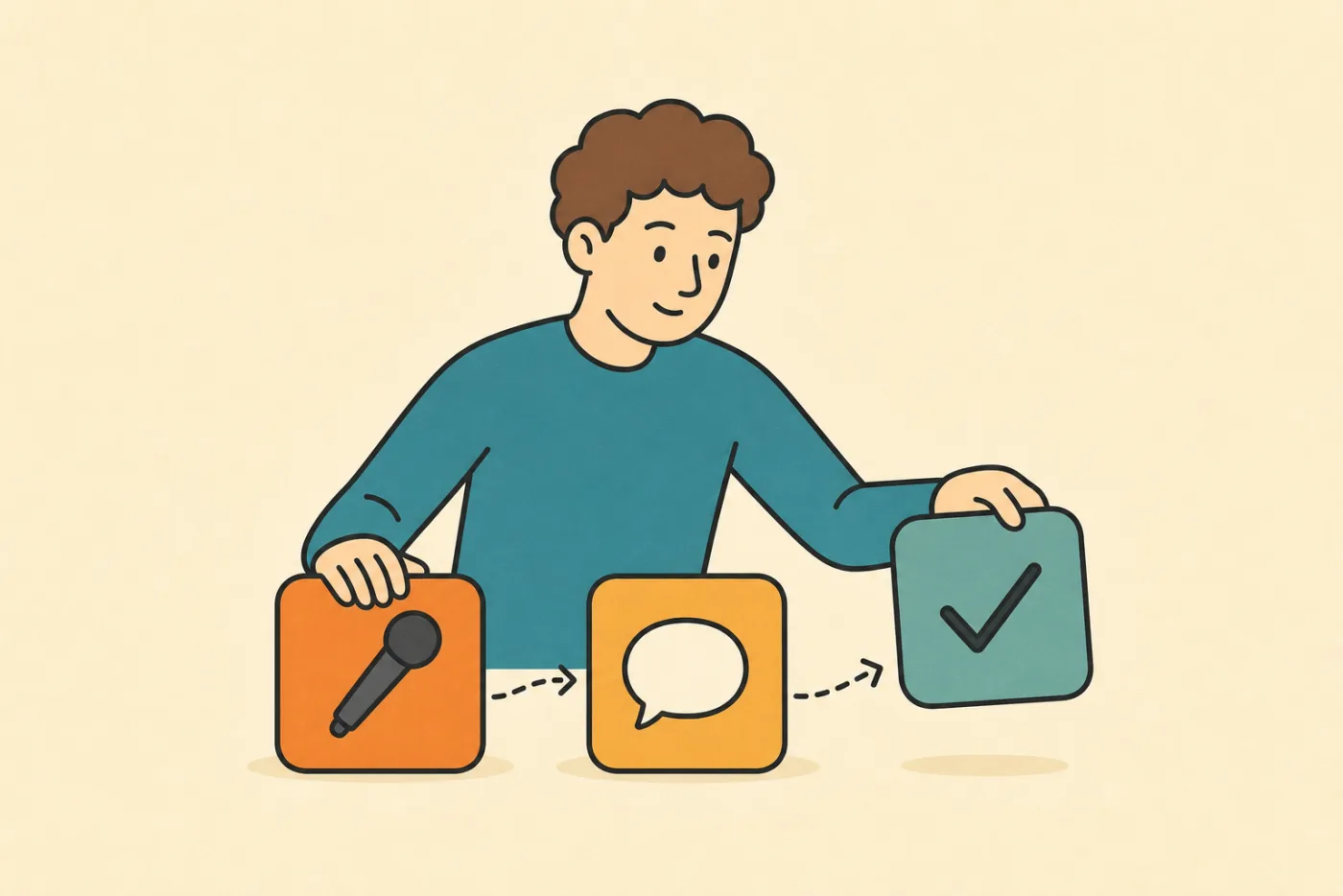
Public speaking skills improve when you practice the exact moment that usually breaks down. For this topic, that means improving the parts of delivery the listener actually notices.
The method is to practice clarity before performance.
The quick version
- Start with a useful first sentence.
- Use examples instead of vague claims.
- Pause when the answer starts to rush.
- Measure progress by clearer delivery.
Start with the first sentence
The first sentence gives the listener a path. If you start with too much background, the audience has to wait before they know what your answer is about.
Practice opening with the point.
- "The main point is..."
- "The reason this matters is..."
- "The simplest way to explain it is..."
- "I would focus on one tradeoff..."
These openings are useful public speech skills because they work even when you are nervous. They also transfer to impromptu speech practice, where you have less time to prepare.
Use examples instead of vague claims
A public speaker becomes easier to trust when the idea becomes concrete. Instead of saying "communication matters," show how communication changes a decision, a meeting, or a result.
Use one example at a time. Too many examples can make the answer feel scattered.
For example: "Clear updates matter because they reduce rework. If a project update says only 'we are almost done,' nobody knows what is blocked. A better update says what is done, what is blocked, and what decision is needed."
That is clearer because the listener can picture it.
Control pacing with pauses
Pacing is one of the most overlooked public speaking skills. Many people rush because silence feels risky. A short pause is usually easier to follow than a rushed sentence.
Use pauses before the point, after an example, and before the close. Do not fill every gap with "basically," "kind of," or "I guess."
If filler words are part of your pattern, use how to stop rambling as a companion drill.
Practice with public speaking exercises
Use exercises that are short enough to repeat.
- One-point drill: explain one idea in 30 seconds.
- Example drill: give one specific example for a broad claim.
- Ending drill: close an answer in one sentence.
- Recovery drill: pause and restart after a messy sentence.
- Q&A drill: answer a surprise question without restarting.
These public speaking exercises are practical because they train the moments where speeches usually break down.
Build a simple practice routine
Use three sessions per week.
- Session 1: opening sentence and pacing.
- Session 2: examples and transitions.
- Session 3: Q&A, recovery, and clean endings.
This turns public speaking strategies into practice. You are not just reading advice. You are training the behavior out loud.
For presentation-specific practice, read speech presentation. For confidence under pressure, read how to speak confidently.
What progress sounds like
Progress sounds like a clearer first sentence, fewer unnecessary details, steadier pacing, and endings that feel intentional.
You may still feel nervous. That is normal. The point is to build effective speaking skills that still work when nerves are present.
Minute Hatch helps you practice public speaking skills with prompts, short recordings, and focused feedback. Start with the public speaking practice app or use the public speaking practice guide for a 60-second routine.
For a next step, read public speaking practice and oratory skills.
Related resources
Keep practicing this topic
Fundamentals of Public Speaking: Start Clear, Stay Useful
The public speaking fundamentals that make practice easier: one point, one example, steady pacing, and a clean ending.
Read guideOratory Skills: Make Your Point Clear and Persuasive
A practical guide to oratory skills: clear claims, useful reasons, concrete examples, rhythm, and short practice drills.
Read guidePublic Speaking for Students: Make Class Answers Clear
A student public speaking guide for clear points, simple structure, class presentation practice, nerves, and feedback.
Read guide