
How to Stop Rambling: Get to the Point Faster
Stop rambling in meetings, interviews, and everyday conversations with a point-reason-example-close structure and a one-minute recording drill.
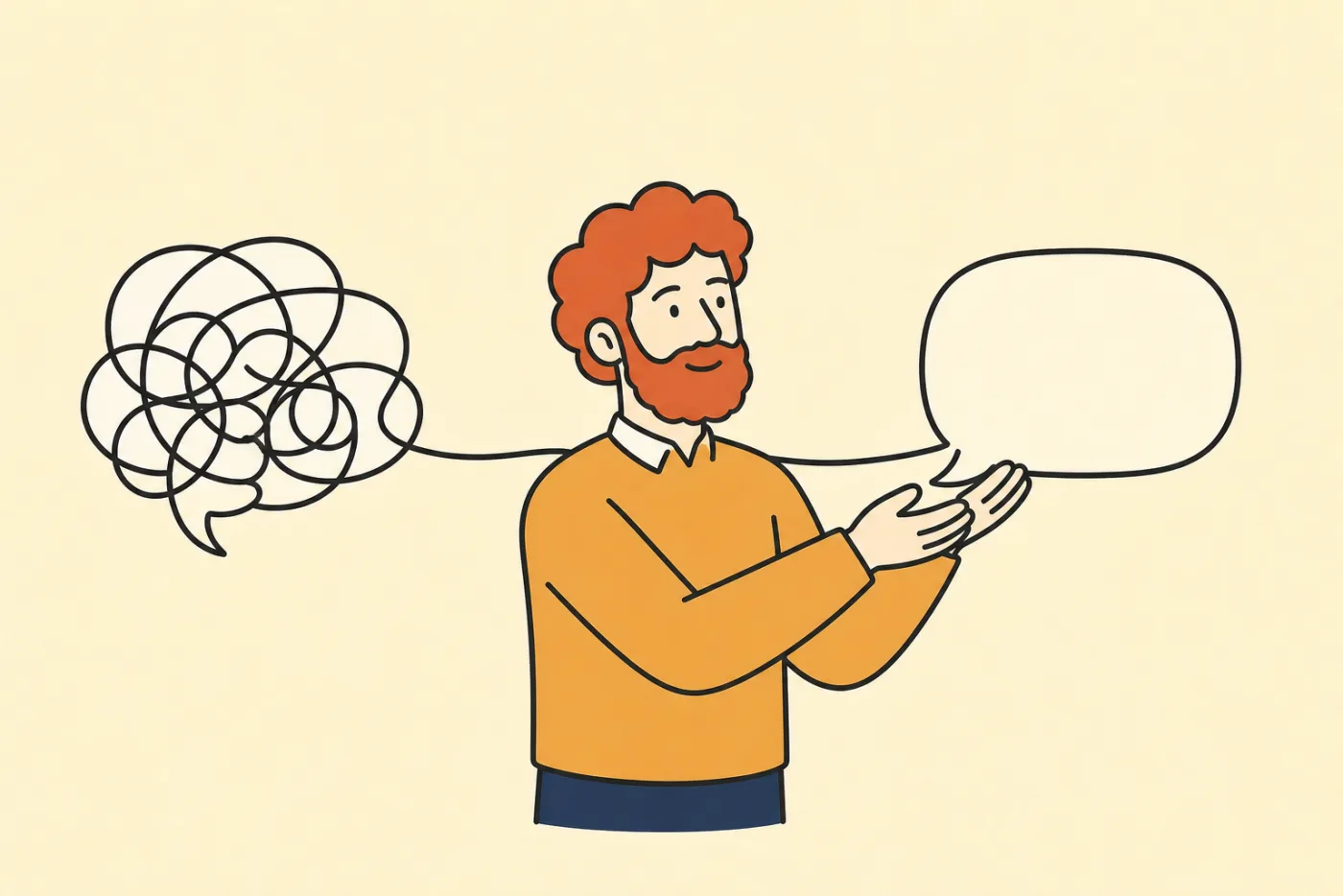
To stop rambling, decide on one point before you start. Then give one reason, add one example, and end with a clear closing sentence.
Rambling is not a personality flaw. It is usually a structure problem: you start answering before you know the point, then keep talking because you are still looking for it.
That is the whole method. It works in meetings, interviews, presentations, and any unprepared speech moment where you have to think while people are listening.
The quick version
If you want to stop rambling, do not try to sound more polished.
Try to make the listener work less.
Use this order:
- Answer the question.
- Give one reason.
- Add one example.
- Stop with a short closing sentence.
For example:
"I would simplify the onboarding flow first. The reason is that every new user sees it before they understand the product. In the last test, people hesitated because the next step was unclear. So I would fix that screen before adding more features."
That answer has a beginning, middle, and end. It does not need another caveat.
Why rambling happens
Rambling usually starts with a reasonable fear: you do not want to leave something important out.
So you add context. Then you add a caveat. Then you explain the exception. By the time you reach the point, the listener has already done too much work.
When nerves are the trigger, the gradual drills in this public speaking anxiety guide can help you slow the first sentence before you structure the rest.
Ask yourself this before you answer:
What is the one thing I need them to understand?
If you cannot answer that in one sentence, more talking will not make the answer clearer.
Start with the sentence they need
Before explaining anything, force yourself to say the answer in one sentence.
Instead of starting with background, start with:
"The main issue is that the user does not know what to do next."
That sentence gives the listener a map. Everything after it can support the point.
This works for work updates, interview answers, public speaking Q&A, and impromptu speech practice.
Before your next answer, pause and ask:
- What is my point?
- What is the strongest reason?
- What example makes it real?
- Where should I stop?
Use a finish line
The biggest change is the last step: stop.
Not every answer needs a second example. Not every answer needs a full history. Not every answer needs a soft landing like "if that makes sense."
A clean ending can sound like:
- "That is the main tradeoff."
- "That is why I would start there."
- "So my answer is yes, but only if we simplify the scope."
- "That is the part I would fix first."
Those lines tell the listener the answer is finished.
Replace filler with a pause
Filler words often show up when your brain is buying time.
That is not a failure. It is a signal to pause.
A pause is cleaner than "basically," "I guess," "kind of," or a repeated setup phrase. It gives you time to choose the next sentence instead of letting the next sentence choose itself.
Try this during spontaneous speaking:
Pause for one second. Say the next useful sentence. If there is no useful sentence, end the answer.
Practice with recordings
You cannot always notice rambling while it is happening. Recording makes it obvious.
Use a one-minute prompt, answer once, then listen for the first moment where the answer becomes less clear. Do not judge your voice. Find the exact sentence where the point starts drifting.
Then record the same prompt again with one rule:
Fewer setup words. One clear point. One example. A clean stop.
This is the same loop used to practice impromptu speaking. The goal is not to sound scripted. The goal is to hear the part of the answer that makes the listener work too hard.
Edit the second take
After each recording, ask three questions:
- Did I answer before explaining?
- Did I use one reason or example instead of three?
- Did I end, or did I keep circling?
This makes editing easier. You are not trying to fix your whole speaking style. You are finding one sentence that made the answer weaker and replacing it in the second take.
What progress sounds like
Progress sounds like shorter openings, fewer repeated points, and cleaner endings.
You may still think out loud when the question is hard. That is normal. The useful change is that you recover faster. You notice when you are drifting, return to the point, and stop when the answer is done.
Minute Hatch helps with this by giving you short prompts, timed recordings, and focused feedback on clarity, confidence, articulation, and next steps. Start with the impromptu speaking practice app or use the public speaking routine if you want a more presentation-focused path.
For a next step, read think on your feet and workplace communication skills.
Related resources
Keep practicing this topic
15 Impromptu Speaking Examples With Sample Answers
Try 15 impromptu speaking prompts for work, interviews, opinions, and everyday life, plus two sample answers and a reusable four-part structure.
Read guideImpromptu Speech PPT: 10-Slide Lesson Plan
Build an impromptu speech PPT with a ready-to-use 10-slide outline, speaking prompts, a simple speech structure, and a practical feedback checklist.
Read guideImpromptu Speech Practice: The 60-Second Loop
A repeatable impromptu speech practice loop for clearer starts, stronger examples, and cleaner endings.
Read guide