
Impromptu Speech Practice: The 60-Second Loop
A repeatable impromptu speech practice loop for clearer starts, stronger examples, and cleaner endings.
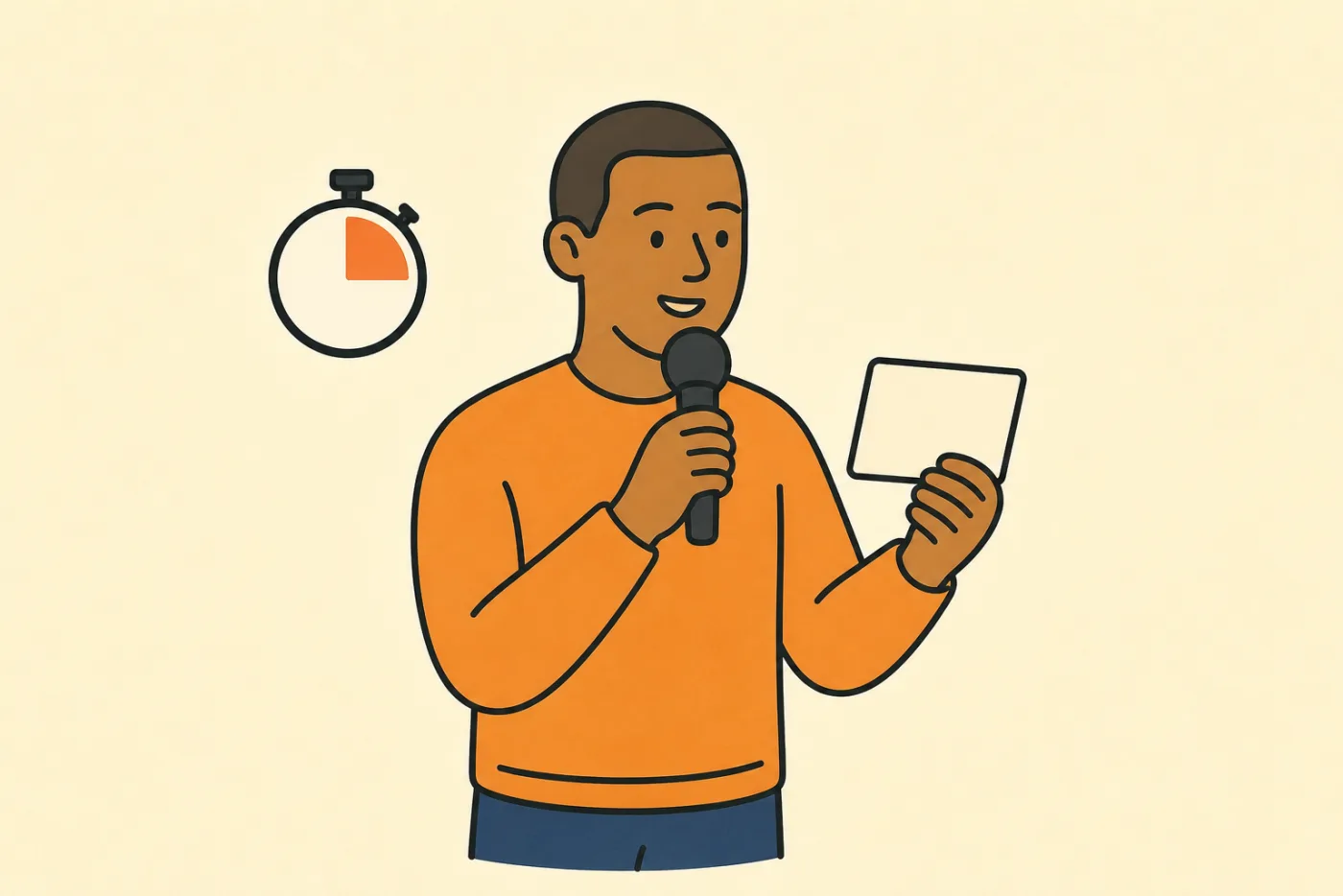
Impromptu speech practice works better when the listener can see the structure quickly. That starts with making unscripted answers easier to repeat and improve.
The method is to practice one short answer, listen, and repeat with one correction.
The quick version
- Pick a prompt you did not prepare.
- Take five seconds to choose the point.
- Record a 60-second answer.
- Repeat once with one improvement.
The 60-second impromptu speech practice loop
- Pick one prompt you did not prepare.
- Take five seconds to choose your point.
- Speak for one minute without restarting.
- Listen for the moment where your answer becomes vague.
- Try the same prompt again with a cleaner structure.
This works because impromptu speaking is not only a confidence problem. It is a structure problem. When you know how to start, support, and close an answer, pressure becomes easier to handle.
Scale the timer without making practice easier to avoid
A timer keeps the answer honest. Without one, it is easy to restart, overthink, or turn a short answer into a long explanation.
Start with 60 seconds. If that feels overwhelming, use 30 seconds until you can finish a clear thought. If it feels easy, move to 90 seconds. The time limit is not the goal; it creates a repeatable constraint while your thoughts are still forming.
Repeat the same prompt on purpose
Repeating a prompt is not cheating. The first answer shows what happens under pressure, while the next answer lets you improve one part without inventing a new idea.
- Take one: speak naturally without restarting.
- Take two: make the first sentence clearer.
- Take three, if useful: make the example more specific and the ending shorter.
Keep the language conversational. A clear human answer is a better target than a polished speech that sounds memorized.
A simple structure for impromptu answers
Use point, reason, example, close.
Your point is the one sentence answer. Your reason explains why you believe it. Your example makes it concrete. Your close lands the answer without adding five more thoughts.
For example, if the prompt is "What skill matters most at work?", a clear answer might start with: "Clear communication matters most because it makes every other skill easier to trust." Then give one work example and close with the outcome.
What to practice first
- Everyday opinion prompts, so you get used to choosing a point.
- Work prompts, so you can explain ideas under pressure.
- Interview prompts, so your answers sound specific instead of rehearsed.
- Public speaking prompts, so you can recover when a question surprises you.
If you freeze often, start with easy prompts. The point is repetition, not difficulty. A simple prompt answered clearly is better practice than a hard prompt answered with panic.
For a ready-made prompt list, use these impromptu speaking examples. If you need a simpler definition before practicing, start with what an impromptu speech is.
What to listen for after each recording
Listen for three things: the first sentence, the middle, and the ending.
The first sentence tells you whether you found a point quickly. The middle tells you whether you supported that point or wandered. The ending tells you whether you knew when to stop.
This is where recording helps. You do not need to guess how you sound. You can hear whether the answer landed.
Where Minute Hatch fits
Minute Hatch is built around short prompts, one-minute recordings, and focused feedback, so you can practice without needing an audience.
You can also use the impromptu speaking practice app page if you want the product flow for speaking on the spot.
For a next step, read impromptu speaking skills or follow the seven-day impromptu speech training plan.
Related resources
Keep practicing this topic
Impromptu Speech: Speak Clearly With No Script
A practical guide to impromptu speech structure, prompts, examples, and one-minute practice.
Read guideExample of Extemporaneous Speech
See an example of extemporaneous speech with a complete one-minute answer, reusable structure, delivery notes, and a simple practice routine.
Read guideImprovisation Speech: Talk Clearly on the Spot
Learn how to handle an improvisation speech by finding a point, structuring it quickly, and talking clearly on the spot without a prepared script.
Read guide