
Stage Fear: Practice the Moment Before You Speak
A practical stage fear guide for smaller stages, first sentences, short practice, recovery, and weekly routines.
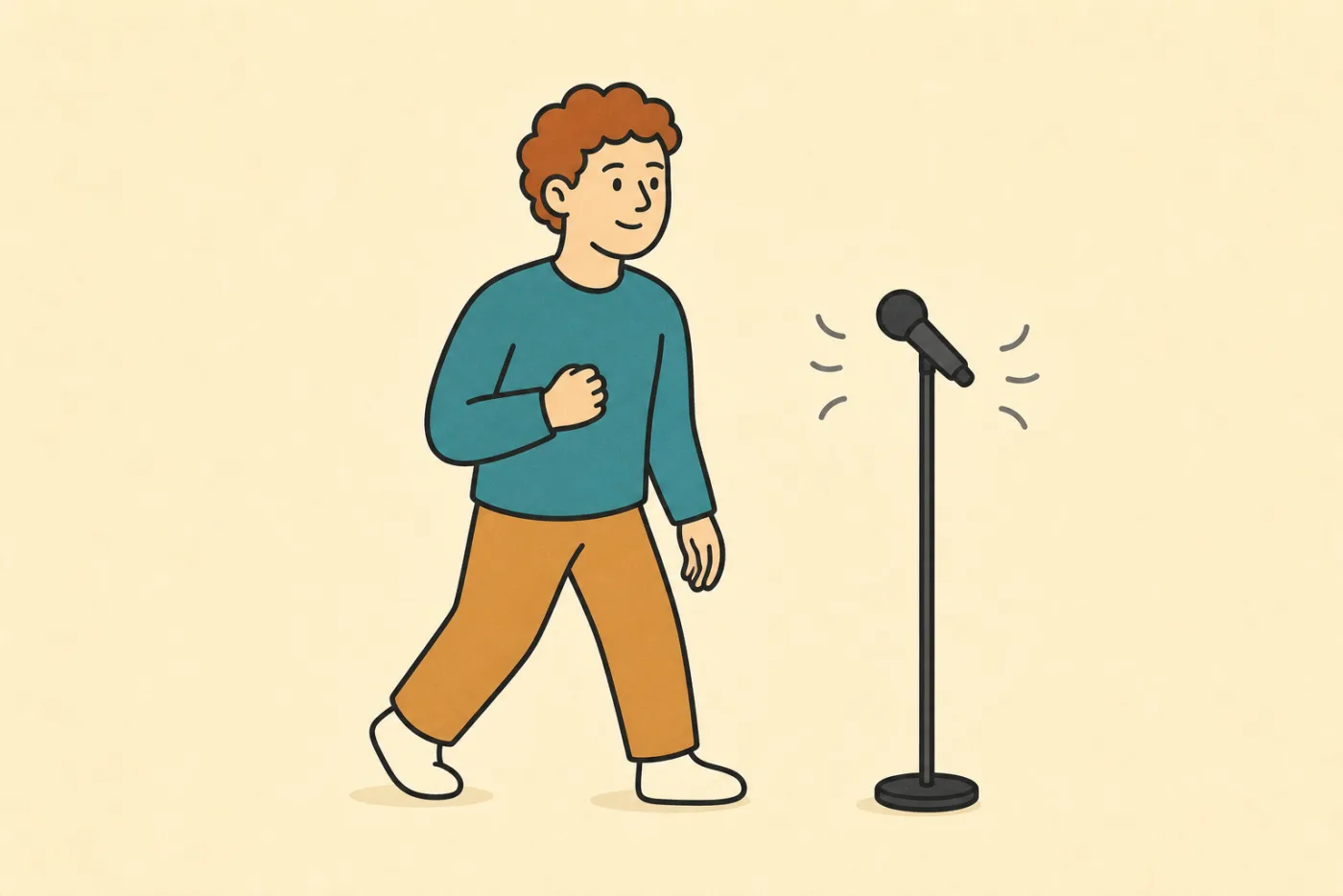
Stage fear gets easier when you stop treating it like a full performance. The useful skill is making the first moments of speaking less unfamiliar.
The method is to practice a smaller version of the stage before the real one.
Start with the short version, then use the examples below as practice reps.
The quick version
- Start with a smaller stage.
- Train the first sentence.
- Use short public speaking reps.
- Practice recovery instead of perfection.
Start with a smaller stage
A stage does not have to mean a room full of people. Your first stage can be a one-minute recording.
Pick a simple prompt, pause for one second, and speak for 60 seconds. The goal is not to sound perfect. The goal is to prove that you can start and finish while some pressure is present.
That small loop is safer and more repeatable than waiting for a real presentation. It also gives you something to review instead of relying on memory.
Train the first sentence
Stage fear usually peaks before the first sentence. Once you start clearly, the pressure often becomes easier to manage.
Use opening patterns you can reach for quickly.
- "The main point is..."
- "The simplest way to say this is..."
- "The reason this matters is..."
- "I would focus on one thing..."
These are not scripts. They are starting handles. They help you avoid opening with panic, apology, or too much background.
If starting is your hardest part, read how to start an impromptu speech and practice the opening lines out loud.
Use short public speaking practice
Short practice works because it lowers the cost of repetition. You can do one prompt before a meeting, before class, or before a presentation rehearsal.
Use this structure.
- Answer directly.
- Give one reason.
- Add one example.
- Stop cleanly.
This is the same core pattern behind public speaking practice. It gives your answer a path, even when you feel nervous.
Practice recovery, not perfection
Stage fear becomes worse when every mistake feels final. Recovery is the more useful skill.
Practice these recovery moves:
- Pause and restart the sentence.
- Say the point in simpler words.
- Use one example when the answer feels abstract.
- End the answer instead of adding nervous extra details.
The goal is not to avoid every stumble. The goal is to know what to do after one.
If nerves make your answers too long, use how to stop rambling as a companion drill.
Stage fear versus public speaking anxiety
Stage fear and public speaking anxiety overlap. Stage fear often describes the pressure of being watched. Public speaking anxiety can include the anticipation before the event, the speaking moment itself, and the review afterward.
In both cases, the practice loop is similar: start small, speak out loud, review one behavior, and repeat.
A weekly stage fear routine
Use three short sessions.
- Session 1: easy prompts, focus on starting.
- Session 2: presentation prompts, focus on pacing.
- Session 3: surprise prompts, focus on recovery.
Do not make the routine dramatic. The more ordinary practice feels, the less rare the speaking moment becomes.
Minute Hatch helps you practice stage fear moments privately with prompts, short recordings, and focused feedback. You can build repetition before the real stage asks for it.
For a next step, read public speaking anxiety and speaking in front of a crowd.
Related resources
Keep practicing this topic
Public Speaking Anxiety: A Step-by-Step Practice Plan
Use gradual exposure, short recordings, calmer openings, and recovery drills to manage public speaking anxiety before high-pressure speaking moments.
Read guidePublic Speaking for Students: Make Class Answers Clear
A student public speaking guide for clear points, simple structure, class presentation practice, nerves, and feedback.
Read guideSpeaking in Front of a Crowd: Practice the First 10 Seconds
A practical guide to speaking in front of a crowd with calmer starts, clear structure, gradual pressure, and recovery.
Read guide