
Speaking Skills Improvement: Practice One Behavior at a Time
A daily speaking skills improvement guide for clearer structure, shorter answers, confidence, and repeatable practice.
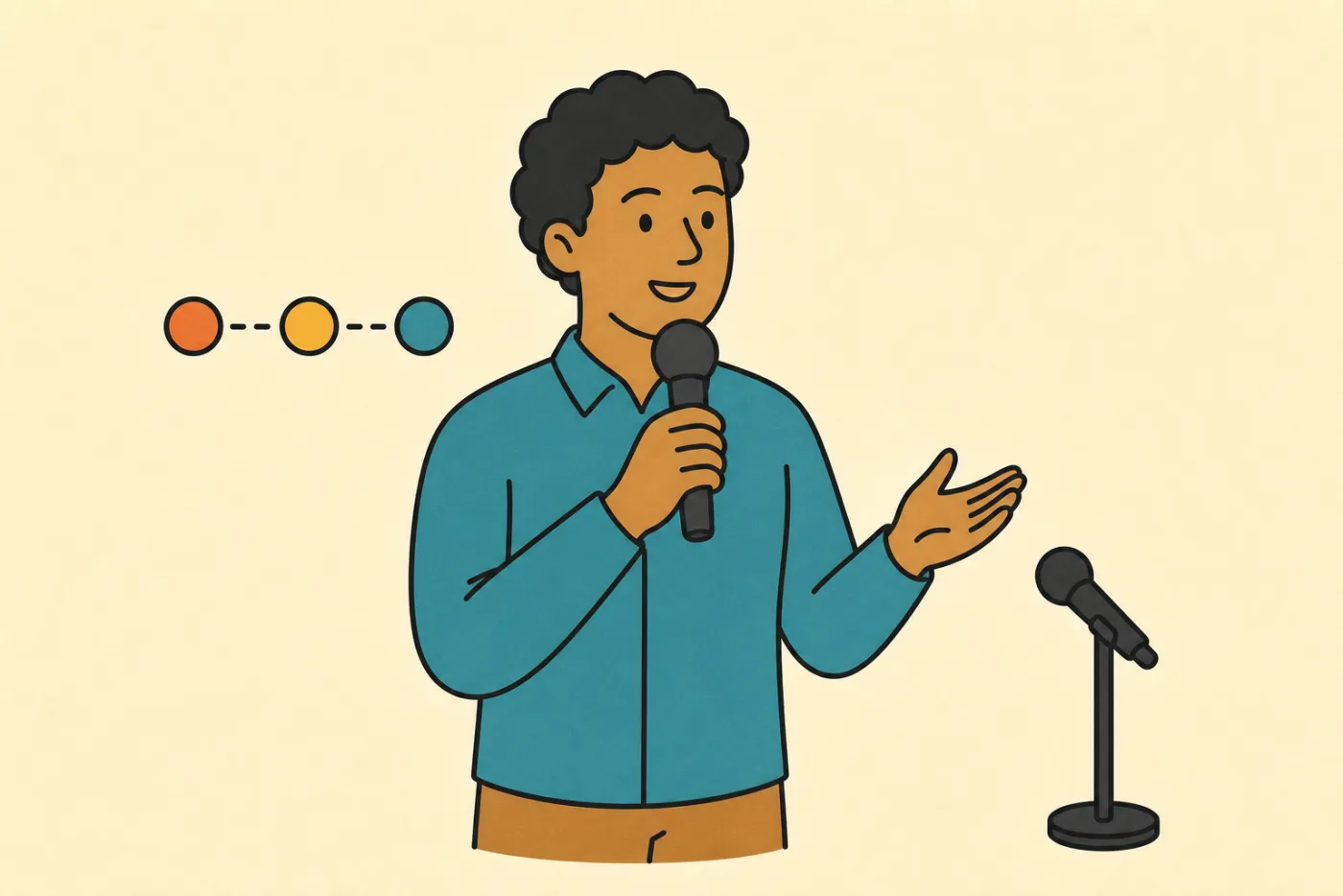
Speaking skills improvement works better when the listener can see the structure quickly. That starts with turning a vague goal into one measurable speaking habit.
The method is to practice one behavior per session.
The quick version
- Choose the behavior you want to improve.
- Use a one-minute practice loop.
- Listen for structure, not perfection.
- Repeat with one specific correction.
What to improve first
Start with the parts that affect almost every speaking situation.
- Opening with the point before the background.
- Using one example instead of several loose details.
- Pausing when you need a second to think.
- Cutting filler phrases that do not add meaning.
- Ending when the answer is complete.
These are useful in meetings, interviews, presentations, networking, and impromptu speaking. They also make practice easier because you know what you are listening for.
Use a one-minute practice loop
Pick one prompt and record a 60-second answer. Do not restart. The first recording shows your default pattern.
Then listen for one thing only. Maybe the opening took too long. Maybe the middle wandered. Maybe the ending added extra sentences after the answer was already finished.
Record the same prompt again and fix only that one thing. This is the simplest form of communication skills practice because it turns a vague goal into a visible correction.
For a more structured version, use the impromptu speech practice routine.
Practice different speaking situations
Speaking skills improvement should transfer to real life. Rotate your prompts so you practice different kinds of answers.
- Work prompts for explaining decisions.
- Interview prompts for telling concise stories.
- Public speaking prompts for presenting one idea clearly.
- Everyday prompts for sounding natural without overthinking.
- Surprise prompts for learning to think on your feet.
This keeps practice from becoming too narrow. You are not memorizing answers. You are training a pattern.
Listen for structure, not perfection
Do not listen to your recording as if you are judging your entire personality. Listen like an editor.
Ask three questions.
- Did the first sentence create direction?
- Did the example make the point easier to understand?
- Did the ending stop cleanly?
If the answer is no, you have a useful next step. If the answer is yes, keep the pattern and try a harder prompt.
Build confidence through evidence
Confidence grows when you hear evidence that your answers are getting clearer. You may still feel nervous, but your speaking pattern becomes more reliable.
This is why short recordings help. They make progress specific. Instead of saying "I need to get better at speaking," you can say "I need to start with the answer before the explanation."
If your main issue is confidence, read how to speak confidently. If your main issue is long answers, read how to stop rambling.
A simple weekly routine
Use five short sessions.
- Day 1: answer easy prompts and focus on the first sentence.
- Day 2: answer work prompts and focus on examples.
- Day 3: answer presentation prompts and focus on pacing.
- Day 4: answer surprise prompts and focus on pausing.
- Day 5: repeat the hardest prompt and make it cleaner.
This is enough to build momentum without turning practice into another task you avoid.
Minute Hatch gives you prompts, one-minute recordings, and focused feedback for confidence, articulation, clarity, and next steps. Use it as a communication skills app for daily speaking practice, or start with the public speaking practice guide if your main goal is presentations.
For a next step, read public speaking practice and practice impromptu speaking.
Related resources
Keep practicing this topic
How to Speak Confidently: Start Before You Feel Ready
A practical guide to speaking confidently by using clear starts, slower pacing, concrete examples, and short practice reps.
Read guideImpromptu Speech: Speak Clearly With No Script
A practical guide to impromptu speech structure, prompts, examples, and one-minute practice.
Read guideImprovisation Speech: Talk Clearly on the Spot
Learn how to handle an improvisation speech by finding a point, structuring it quickly, and talking clearly on the spot without a prepared script.
Read guide