
Impromptu Talk: Speak Clearly Without Notes
A practical impromptu talk guide for short unscripted answers, examples, prompts, and repeatable practice.
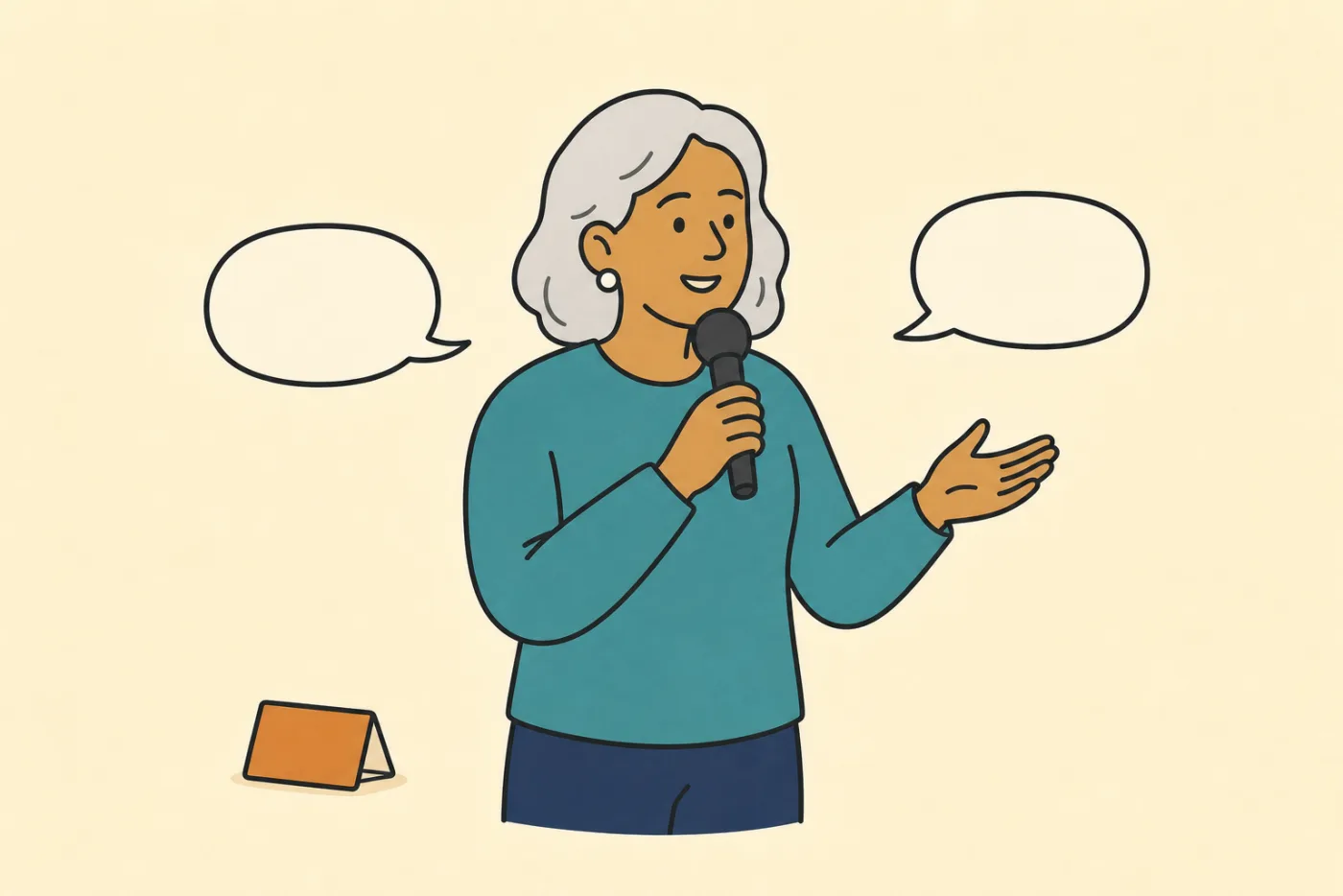
An impromptu talk gets easier when you stop treating it like a full performance. The useful skill is making a short unscripted answer feel organized.
The method is to make the talk narrow enough to finish cleanly.
Start with the short version, then use the examples below as practice reps.
The quick version
- Choose one angle.
- Say the point in the first sentence.
- Use one example to make it real.
- End with the takeaway.
Impromptu talk vs impromptu speech
An impromptu speech usually sounds more formal. An impromptu talk is more conversational.
The structure is still similar:
- Say the point.
- Explain why it matters.
- Give one example.
- End with the takeaway.
That is enough for most workplace, interview, and Q&A moments.
A simple impromptu talk template
Use this template when you do not know how to start:
- My short answer is...
- The reason is...
- For example...
- So the takeaway is...
This keeps your answer from turning into a long search for the point. You are giving yourself a path while you speak.
If the question is broad, narrow it before answering. Say, "If we are talking about the next step..." or "For this situation..." That gives the listener context and keeps the talk from becoming too general.
Example impromptu talk
Prompt: Should people practice speaking before important conversations?
Answer: My short answer is yes, because important conversations usually feel harder when the first draft happens live. For example, if someone needs to explain an idea in a meeting, a one-minute rehearsal can reveal whether the point is clear or too vague. The takeaway is that practice does not need to make you sound scripted. It can simply make your first sentence stronger.
That answer works because it gives one point, one reason, one example, and a close.
How to practice impromptu talks
Use short prompts and record yourself for 60 seconds. After each take, listen for:
- Whether your first sentence had a point.
- Whether the middle supported that point.
- Whether the ending stopped cleanly.
- Whether filler words appeared when the structure got weak.
This is the same loop used in impromptu speech practice, but the tone can stay more natural and conversational.
Prompts for your next impromptu talk
- What makes a conversation productive?
- What is one skill every professional should practice?
- Should people rehearse hard conversations?
- What makes someone sound credible?
- How do you explain a complex idea simply?
If you want more prompts, use these impromptu speaking examples.
Practice with Minute Hatch
Minute Hatch gives you short prompts, one-minute recordings, and focused feedback so you can practice an impromptu talk before the moment matters.
Use this guide to practice impromptu speaking with a repeatable routine.
For a next step, read spontaneous speaking and impromptu speaking examples.
Related resources
Keep practicing this topic
Impromptu Speech: Speak Clearly With No Script
A practical guide to impromptu speech structure, prompts, examples, and one-minute practice.
Read guideImprovisation Speech: Stay Clear Without a Script
A practical way to handle improvisation speech with a simple structure, prompts, and short practice reps.
Read guideExtemporaneous Speech Example: Structure You Can Reuse
A reusable extemporaneous speech example with a clear point, one reason, one example, and a clean ending.
Read guide