
15 Impromptu Speaking Examples With Sample Answers
Try 15 impromptu speaking prompts for work, interviews, opinions, and everyday life, plus two sample answers and a reusable four-part structure.
These 15 impromptu speaking prompts cover everyday conversations, work, interviews, and opinion questions. Two full sample answers show how to turn a prompt into a clear one-minute response.
The method is to use each example as a one-minute speaking rep.
If the format is new to you, first read what an impromptu speech is.
Use the quick version first. Then practice the detailed sections out loud.
The quick version
- Pick one prompt you did not prepare.
- Answer with one point, reason, example, and close.
- Listen for the sentence where the answer drifts.
- Repeat the same prompt once with a tighter point.
Everyday impromptu speaking examples
- What is one habit you want to keep?
- What is a skill everyone should learn?
- What makes a conversation memorable?
- What is one small thing that improved your week?
- What is something you used to believe but changed your mind about?
Everyday prompts are good warmups because they let you focus on structure instead of knowledge.
Work and interview examples
- Explain a project you are proud of.
- Describe a time you changed your approach.
- What makes someone reliable at work?
- How do you handle unclear instructions?
- What is a useful mistake you made recently?
These prompts help with interviews, meetings, and spontaneous workplace communication. They train you to explain experience without rambling.
For interview-style practice, add one detail that proves the answer is real: a constraint, a tradeoff, a result, or what you learned. Specific details make short answers sound more credible.
Opinion prompts
- Is confidence more important than preparation?
- Should people speak more slowly in meetings?
- What makes an idea easy to understand?
- Is it better to answer quickly or thoughtfully?
- What is the difference between sounding smart and sounding clear?
Opinion prompts are useful because they force you to choose a side, give a reason, and defend it briefly.
If you struggle to choose a side, pick the answer you can explain most clearly. Impromptu speaking practice is not a debate tournament. The training value comes from committing to one point and making it understandable.
How to answer each prompt
Use this structure: answer, reason, example, close.
For the prompt "What makes an idea easy to understand?", you could say: "An idea is easy to understand when the listener knows what problem it solves. Without that, even a clever idea sounds vague. For example, if I describe a feature before explaining the user pain, people focus on details instead of the value. So I would always start with the problem, then explain the idea."
That answer is not long, but it has a point, support, and a close.
A model answer you can practice
Try this prompt: What makes someone reliable at work?
Here is one answer: "I think someone is reliable when people know what they can expect from them. It does not mean they always have the answer immediately. It means they communicate early when something is unclear, then follow through on the next step. For example, if I needed more time to check the numbers in a project, I would say that before the deadline instead of promising an update I could not deliver. That gives the team time to adjust and keeps the work moving. So, to me, reliability is clear communication followed by consistent action."
This is a useful 80 percent target for practice. It answers the prompt in the first sentence, uses one concrete example, and closes with a simple conclusion. It sounds prepared enough to be clear, while still sounding like a real answer someone could give in a meeting or interview.
A second 60-second impromptu speech example
Try this prompt: What skill matters most at work?
Here is one answer: "The skill that matters most at work is clear communication. Talent is hard to trust if nobody understands what you mean, what you need, or what you are trying to solve. For example, a smart teammate can still create confusion with vague updates, while someone who explains the problem, the next step, and the decision needed can make the whole team move faster. That is why I would choose communication. It does not replace technical skill, but it makes that skill easier for other people to use."
This example works because it has one point, one reason, one concrete situation, and one close. It also answers immediately instead of spending the opening defining the topic.
The same structure works for meetings, interviews, and other moments of unprepared speech.
Use the same template for your own answer:
- I think the answer is...
- The reason is...
- For example...
- So the main point is...
Turn examples into practice
Pick one prompt from this page and record a one-minute answer. Then listen for the first sentence. If the first sentence did not answer the prompt, try again.
 Minute Hatch
Turn the next prompt into a 60-second practice round.
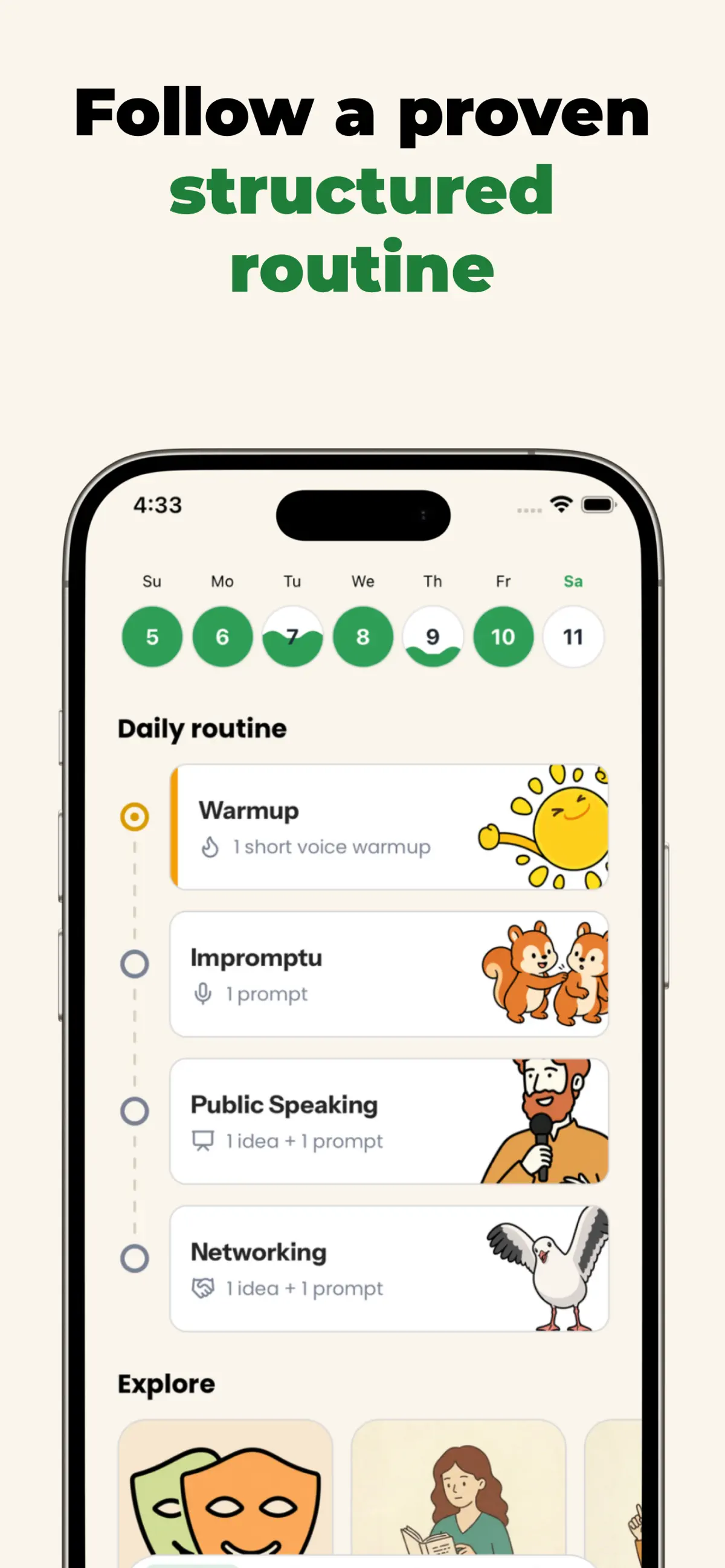
Get an unexpected prompt, record one take, and use focused feedback to make the next answer clearer.
- Unexpected prompts
- One-minute recordings
- Focused feedback
 Download on the App Store
The impromptu speaking practice app explains how Minute Hatch turns the same loop into short, private recording sessions.
For a more guided routine, read impromptu speech practice.
For a next step, read how to start an impromptu speech, then record one of the examples above in your own words.
Related resources
Keep practicing this topic
How to Stop Rambling: Get to the Point Faster
Stop rambling in meetings, interviews, and everyday conversations with a point-reason-example-close structure and a one-minute recording drill.
Read guideImpromptu Speech About Love: Examples and Prompts
A clear way to structure an impromptu speech about love, self love, relationships, or a personal value.
Read guideImpromptu Speech PPT: 10-Slide Lesson Plan
Build an impromptu speech PPT with a ready-to-use 10-slide outline, speaking prompts, a simple speech structure, and a practical feedback checklist.
Read guide