
Make Your Ideas Easier to Take Seriously
Why strong ideas can sound weak, and how clearer structure, fewer filler words, and better examples make people listen.

Explaining your ideas becomes easier when the answer has a visible path. The path here is making good thinking easier for other people to trust.
The method is to remove the delivery problems that make the listener work too hard.
Read the quick version first, then use one section as your next practice rep.
The quick version
- Say the point before the background.
- Cut filler that weakens the claim.
- Use vocabulary that fits the room.
- Give one example people can repeat later.
Mumbling
Mumbling usually gets worse when you rush. A single unclear word can make the listener pause and reconstruct the sentence, which breaks trust in the answer.
A simple articulation drill is to place a pen lightly between your teeth and read a short paragraph slowly. The point is not to sound natural during the drill. The point is to exaggerate mouth movement, then remove the pen and read the same paragraph again with cleaner pronunciation.
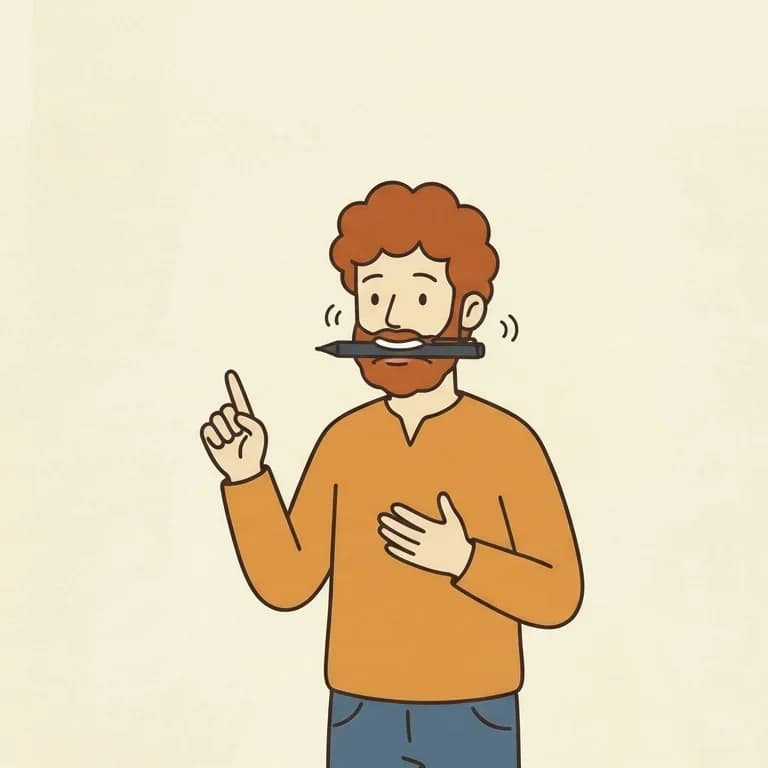
Tongue twisters can help too, especially when you slow them down. Try "unique New York" or "red leather, yellow leather" at half speed before trying to go faster.
Filler words
Filler words are not automatically bad. In everyday conversation, a few fillers can sound normal. The issue is when fillers replace structure.
If every sentence starts with "um," "like," or "you know," the listener may hear uncertainty even when the idea is good. The better replacement is not silence forever. It is a short pause before the next sentence.
If filler words show up when you are put on the spot, the deeper issue is usually structure. Start with spontaneous speaking and practice giving yourself a pause before the answer begins.
Sentence structure
Clear sentence structure makes your idea easier to trust. In most work conversations, you do not need a dramatic speech. You need a point, a reason, and a concrete example.
Start with easy 20-second prompts if 60 seconds feels too long. Explain your morning routine, what you ate for breakfast, or one simple opinion. Then move to work prompts, decisions, tradeoffs, and questions that require more precise language.
The structure that helped most is simple: point, reason, example, close. The impromptu speech training plan turns that into a repeatable week of practice, and impromptu speaking skills breaks the drills into smaller parts.
Vocabulary should match the setting
Vocabulary affects credibility, but the goal is not to use complicated words. The goal is to choose words that fit the setting.
In a formal meeting, vague slang can weaken the point. In a casual conversation, overly technical language can sound stiff. A useful habit is to practice explaining the same idea in two versions: one simple version for a general listener and one precise version for a specialist.
Minute Hatch was built for this kind of daily speaking practice: short prompts, one-minute recordings, and feedback on clarity, confidence, articulation, and next steps.
For a next step, read workplace communication skills and how to stop rambling.
Related resources
Keep practicing this topic
Example of Extemporaneous Speech
See an example of extemporaneous speech with a complete one-minute answer, reusable structure, delivery notes, and a simple practice routine.
Read guideHow to Stop Rambling: Get to the Point Faster
Stop rambling in meetings, interviews, and everyday conversations with a point-reason-example-close structure and a one-minute recording drill.
Read guideImpromptu Speech Practice: The 60-Second Loop
A repeatable impromptu speech practice loop for clearer starts, stronger examples, and cleaner endings.
Read guide